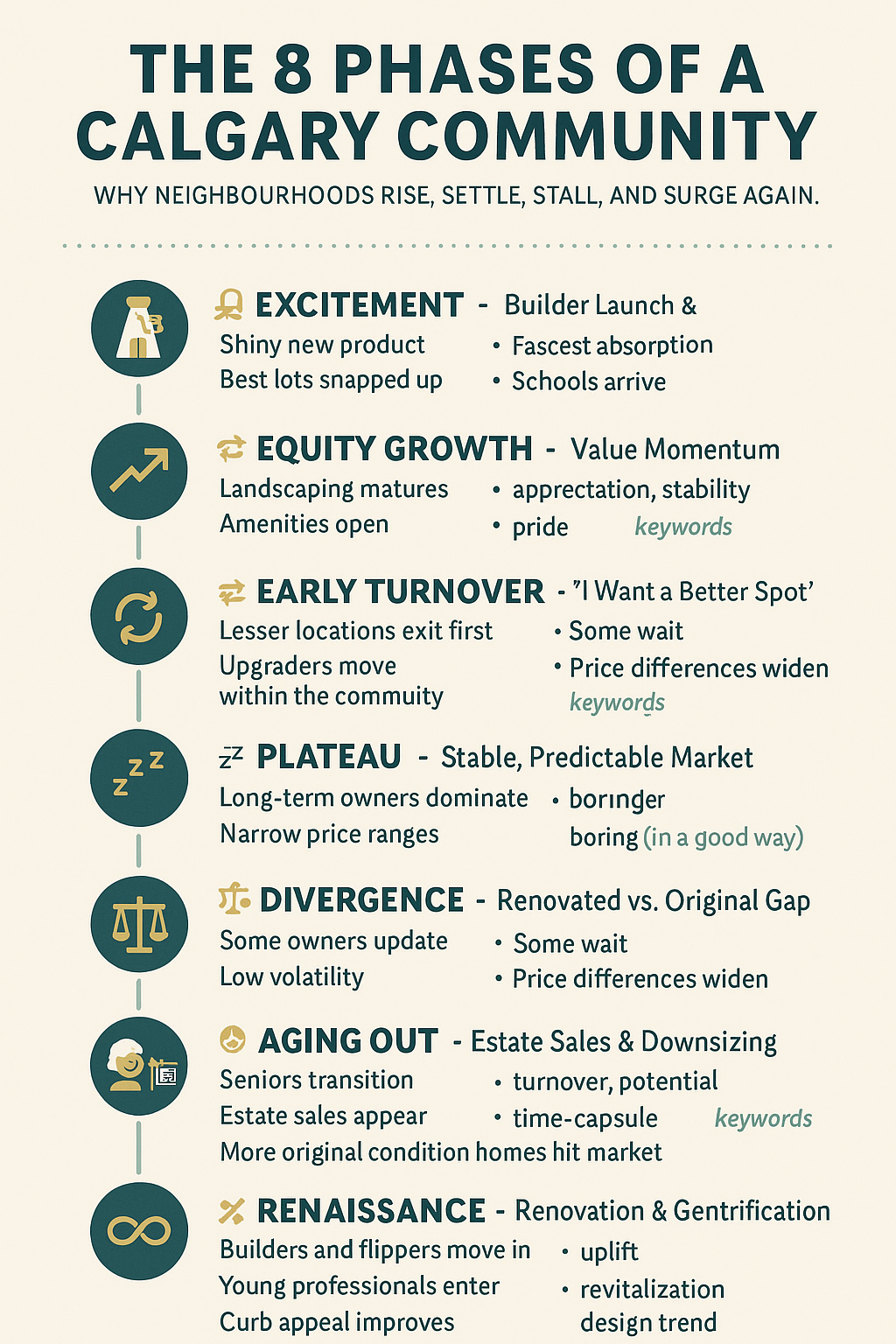
(Why Neighbourhoods Rise, Settle, Stall, and Surge Again)
Every Calgary community has a story. It’s not random. It’s not luck. It’s predictable. Once you understand the life cycle of a neighbourhood, you start to see the city differently — especially if you’re buying, selling, or investing.
Let’s walk through the phases most Calgary communities quietly pass through.
1. The Excitement Phase — Birth of a Community
It starts with a name, a master plan, and a few brave showhomes in a muddy field. The builders move in, the marketing banners go up, and suddenly everyone’s talking about the new “it” area.
Buyers line up:
shiny quartz,
fresh paint smell,
“no one has lived here before” bragging rights.
Most early sales never hit MLS. They go straight from builder to buyer. Great locations? Snapped up instantly — often by people who know they’ll be irreplaceable.
2. The Equity Phase — Early Appreciation
In Calgary, the first 5–10 years are usually good to great. Prices rise, landscaping matures, schools open, traffic patterns normalize, and the neighbourhood starts to feel… real.
Owners build equity without doing anything heroic.
And with that equity comes…
3. The Shuffling Phase — Early Turnover
Not everyone nailed their lot choice. Some got:
power lines,
busier streets,
smaller yards,
less sunlight,
problematic neighbours (don’t worry, we all get one eventually).
These are the first movers.
As they upgrade within the community, turnover increases. The neighbourhood becomes a hive of sold signs and moving vans.
Investors start sniffing around.
4. The Plateau Phase — Stability
Eventually, turnover slows. The easy upgrades are done. Owners settle in. Kids grow. Mortgages shrink.
Price ranges tighten.
Sales become boringly predictable.
“Stable” becomes the word.
This is where communities spend most of their lives.
Investor note: this is when rents become wonderfully boring and vacancy almost disappears.
5. The Divergence Phase — Aging Stock
As homes age, you start to see two distinct species:
Original Condition
Same cabinets the builder used when radios had knobs.Renovated
New kitchens, new bathrooms, maybe a second mortgage hiding in the basement.
Now price spreads widen — sometimes dramatically. This is where charts start looking like someone spilled glitter. The difference between high and low becomes the Area of Opportunity.
Buyers with vision thrive here. Renovators feast.
6. The Transition Phase — Seniors Age Out
Calgary has a lot of communities built in the 60s, 70s, and 80s. Eventually, original owners:
downsize,
move to retirement communities,
pass properties to estates.
These homes are often immaculate time capsules with:
great bones,
huge lots,
no lipstick.
Turnover accelerates again.
Builders quietly circle, calculators glowing.
Prices start rising — not because the homes are stunning, but because the potential is.
7. The Renaissance Phase — Gentrification
Now the community gets interesting.
Renovated homes start commanding premium prices.
Ultra-original homes get snapped up as projects.
Younger professionals move in.
Contractors become local celebrities.
Before long, the area looks nothing like it did a decade ago — in a good way.
At this point, the price spread (high vs low) can double. Investors love this window. Realtors love it more.
8. The Legacy Phase — The Cycle Repeats
Communities don’t die.
They cycle.
New construction steals attention, older homes age into charm, and the strong locations outperform forever.
And the “best lots” — the ones snapped up in phase one — often never hit MLS again. They quietly transfer owner to owner, hidden from the public.
This skews data, averages, and public perception.
So What Does This Mean for You?
Buyers:
Don’t judge a community by its current state — judge it by its phase. Opportunity hides between the phases.
Sellers:
List when your phase favours demand. If your community’s entering divergence or transition, price power is on your side.
Investors:
The sweet spot is simple:
aging stock,
wide price spread,
quiet turnover acceleration,
unrenovated originals still available.
That’s how you buy with a margin of safety.
Calgary is a City of Cycles
Suburbs become established.
Established communities become classic.
Classic communities become desirable.
And eventually, they become expensive.
Meanwhile, something shiny breaks ground on the edge of the city — and a new story begins.
Real estate isn’t about bricks, drywall, or granite. It’s about timing, phase recognition, and anticipating the next chapter in a community’s life.
If you want help reading the cycle instead of guessing, reach out.
The best deals aren’t random.
They’re predictable — if you know what phase you’re looking at.
Check Out 365Calgary.com for lists and stats for the Calgary Housing Market.